ERMI Analysis and Vacuum Sampling Kit
From $579
Order incl. GST
Collect a dust sample at home and post it back to our laboratory for a DNA-based, scored result. Here is how each test works, what it looks at, and which one tends to suit which situation. Every analysis uses DNA technology and comes back with a plain-English interpreted report.
Performing an ERMI is a way to determine whether the presence of water damage in a building (WDB) has caused mould amplification, which can very likely cause negative health consequences for the occupants.
Samples for ERMI are analysed using Mould Specific Quantitative Polymerase Chain Reaction (MSqPCR). The data obtained is assessed and interpreted by reference to a database of similar ERMI data acquired from normal homes. The test is an objective, sensitive and standardised method that can identify and quantify selected mould species.
The usual sample is settled dust collected in homes and buildings to determine the concentrations of the DNA of the different species of mould. While there is a wide spectrum of moulds that can be analysed this way, 36 species are detected. The research behind the procedure selected 26 of those moulds as being associated with WDB (the Group 1 mould) and 10 common species (Group 2) that were not found to be associated with WDB. To calculate the ERMI, we total the individual log10 values of the Group 1 mould, total the individual log10 values of the Group 2 mould, and take the difference between the two totals.
Simply put, a home or building with a high ERMI value has a greater chance of causing a mould problem for its occupants than one with a lower ERMI.
The US Environmental Protection Authority (USEPA) developed ERMI to provide a straightforward, objective, sensitive and standardised way to assess mould, using a ranking system based on dust samples collected from homes. The ERMI helps predict the mouldiness of homes.
Based on widely published data from EPA researchers and the 2006 HUD American Healthy Home Survey, the test was developed as a tool to evaluate the potential risk of indoor mould growth and its associated health effects on occupants.
To use this tool most effectively, the ERMI obtained needs to be compared to a national database. Indices were determined using this method for 1,096 homes across the U.S. as part of the 2006 HUD American Healthy Home Survey. Individual indices, ranked from lowest to highest, were used to create a national Relative Mouldiness Index (RMI) scale.
In initial studies by the USEPA, the concentrations of different mould species in "mouldy homes" (homes with visible mould growth or a history of water damage) and "reference homes" (homes with no visible mould) were compared. Based on those results, mould species were selected and grouped into those with higher concentrations in mouldy homes (Group 1) and those with lower concentrations (Group 2).
The ERMI process involves the analysis of a dust sample from a home or other building. Dust is first extracted from the sample provided, then fungal DNA is extracted and purified from the dust. This fungal DNA is then analysed using MSqPCR, a highly specific DNA-based method for quantifying mould species.
The ERMI graph makes it possible to compare one house's "mouldiness" with another without being a statistician, and a reference table helps with interpreting the result.
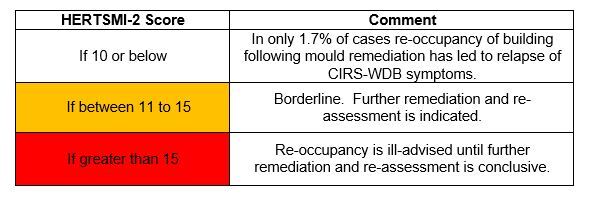
HERTSMI-2 is a DNA-based MSqPCR test that analyses the dust sample provided for 5 particular moulds, known as the "Big 5". HERTSMI-2 is an acronym for Health Effects Roster of Type Specific Formers of Mycotoxins and Inflammagens, 2nd Version. The HERTSMI-2 score provides an indicator for people suffering from Chronic Inflammatory Response Syndrome (CIRS) as to whether it is safe for them to occupy their home without a recurrence of symptoms.
Sufferers can compare their score against the Surviving Mold HERTSMI-2 scorecard and reference graph to interpret the result.
Polymerase Chain Reaction (PCR) technology is used by our lab as a detection method for various organisms, using specially designed probes and primers developed exclusively for the laboratory.
Fungal or bacterial DNA is extracted, purified and combined with specific primer-probe mixes to identify the species of mould or bacteria that may be present in the sample.
At NSJ EnviroSciences we can perform presence/absence PCR detection for a number of microbes, including Human Bacteroides and Actinomyces, from a variety of sample types. Other organisms can be detected by special request. Please contact the lab for more information.
Next Generation Sequencing (NGS) involves the massively parallel sequencing of millions of DNA fragments, which minimises the need for the fragment cloning used in traditional Sanger sequencing methods. Parallel sequencing provides vast amounts of data quickly and at an affordable cost. This enables in-depth analysis of entire genomes at unprecedented levels, allowing researchers to explore questions that previously would have taken years to answer.
Sequencing is the process of determining the precise order of nucleotides within the genome. It includes various methods used to determine the order of the four nucleotides in the DNA strand. The advent of rapid DNA sequencing methods has greatly accelerated biological and medical research and discovery.
Using NGS, we can study how you interact with the microbial co-inhabitants of your home or work, without being limited by the methodological constraints of the past. NGS lets us determine and quantify the fullest spectrum of the microbiota in your environment.
This technology has a vast array of applications, such as:
DNA techniques have been used to identify and isolate the genes responsible for certain diseases and to provide a correct copy of a defective gene, known as genetic testing. As genetic testing becomes more widespread and accessible, it has the potential to improve health outcomes for millions of people worldwide.
Browse the full range of kits, or head straight to the order page and post your sample back to our lab.